| Created: March 7, 1999. Last update: December 28, 1999 | © Stephen Alsford, 1999-2003 |
The York street (now pedestrianized) of Stonegate, was one of the main roads of the Roman city and, as such, would have been paved with stone – hence the name that Norse settlers gave it when they established themselves in the former Roman base of Eboracum, subsequently an Anglo-Saxon administrative centre (Eoforwic). The Norse made the place, which in their tongue was "Jorvik", a commercial centre of the kingdom they established in northern England.
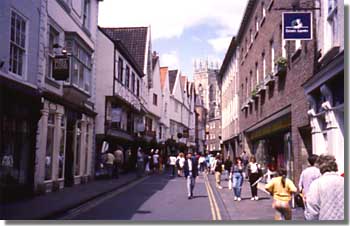
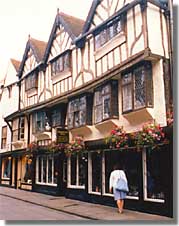
Stonegate is lined with buildings representing architecture from many periods in history; some timber-framed buildings heark back to the late Middle Ages. Mulberry Hall, for instance, was built in the fifteenth century. Most of these buildings are today shops at ground-floor level. The street led from the community hall, passing by the marketplace, and terminated, as it still does, at the cathedral. When the street was laid out by the Romans, its purpose was to connect the headquarters of the legion based at Eboracum to one of the gates in the city wall.
A number of English boroughs had their shape and layout influenced by preceding Roman settlements. Even though Roman features may have become obscured or obliterated during the decline of urban society in the Early Middle Ages, the Roman walls and gates (the likeliest feature to survive) influenced later settlers to recreate – perhaps unknowingly – the grid pattern of streets originally laid down by the Romans; Colchester provides another example. The shapes of other towns were influenced by a variety of factors, such as the intersection or convergence of highways (land- and/or water-based), the presence of a fortification or religious house, the curve of a river, access to a sheltered harbour, the availability of an open flat area, the preoccupations (e.g. protection, agriculture, commerce, industry) of the peoples who settled in these locations at different periods, as well as specific historical events that owe little or nothing to topography. These often interacting factors produced the great variety of medieval town plans many of whose features may still be traced in their modern descendants.