| Created: March 7, 1999. Last update: November 2, 2014 | © Stephen Alsford, 1999-2014 |
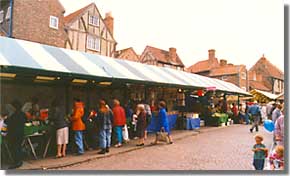
The Newgate Market in York has a strong flavour of a medieval marketplace, surrounded by merchants' houses and inns, and with church towers rising in the background. Ironically, this was not in fact one of the medieval marketplaces but was established in 1955. In the Middle Ages goods were bought and sold in a number of locations, but particularly the Thursday Market, to the west (now St. Sampson's Square), and Pavement, to the south -- the latter a street market, that spread out into adjacent streets; due to post-medieval redevelopment, neither of these now has much that brings to mind a medieval marketplace. My first experience of the Newgate Market was on a late afternoon in November when the marketplace was shrouded in mist, creating a blurring effect which only made it easier to imagine how a marketplace might have looked in the fifteenth century.
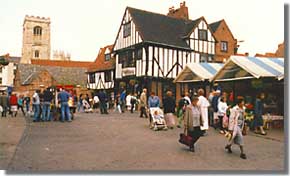
Markets and commercial privileges were fundamental features of towns (although not exclusive to towns), and the development of trade was a major factor in urbanization. The marketplace was a focal point, both economically and socially, of – and often a fairly central space (as in York) in – the town. It might take the form of a large open space, or be held along one or more streets of the town. Often certain types of goods were sold in particular, set locations; e.g. in York, meat was sold by local butchers in the Shambles (just off the modern Newgate Market), although it was also sold in the Thursday Market, while fish and poultry was sold on the Ouse and Foss Bridges.
Some characteristics of the medieval market have lasted into the twentieth century. The selling of goods from stalls, in the open air, was typical of much medieval retailing; the stalls in the Newgate Market seem to have about the same length and width dimensions sometimes found specified for medieval stalls. Although craftsmen would have workshops in their residences, most selling of goods was done from through the ground-floor front windows of houses, from temporary stalls outside the houses, or in a marketplace (or similar area designated for retailing). Over time some of these stalls became more elaborate and permanent fixtures, and evolved into the modern shop. This conversion process often meant that parts of the original marketplace were lost to the structures in process of becoming permanent buildings.
The public character of retailing was important, particularly since some bargaining would be involved. The marketplace brought retailing into a venue where both community and local authorities could see that trading was conducted fairly, with goods (above all, foodstuffs) freely available to all-comers, of a satisfactory quality, and offered at a fair price. Ordinances were made to restrict or prohibit retailing in private places or outside normal market hours. The purpose of the marketplace was also to allow producers of goods to sell directly to the public, without intervention of middlemen who might seek a profit by raising prices or lowering quality or quantity. Thus a set of ordinances made by York's government in 1301 included the specifications that:
Of course, the fact that such regulations were necessary is itself witness to contrary practices; profiteering is innate to commercial activity and was not to be controlled.