 History of
medieval YorkHistory of
medieval York
History of
medieval YorkHistory of
medieval York
| Buildings and fortifications |
The loss of most of the early records of the city has been compensated for somewhat by the survival of a built fabric in which there are an unusually high number of medieval elements, together with a strong archaeological programme in recent decades which in particular has thrown important new light on pre-Conquest York. The cathedral and castle keep were doubtless the most prominent features on the city skyline, along with the towers of the medieval parish churches, of which there were about forty, while the abbey, priories, hospitals, and friaries must also have been among the more prominent buildings of the city.
The late medieval version of the cathedral was rebuilt on a scale intended to rival Canterbury's and in a more modern style than the Norman predecessor. The building programme began with the south and north transepts in the 1220s, continuing with the chapter house> in the third quarter of the century, followed by the nave; rebuilding of the eastern end of the cathedral, in Perpendicular style, was next, then the choir received attention, and finally in the fifteenth century the massive central tower was erected (replacing an earlier tower that collapsed in 1407).
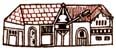
A number of lesser buildings have also survived from the late medieval period – both ecclesiastical structures, such as a college of chantry priests built within the cathedral precinct and ruins of St. Mary's abbey, and secular structures. The latter include three guildhalls – one now associated with the Merchant Adventurers (although not built by them) and another which came to be used by the city government (surviving only as a reconstruction of the medieval original) – and a number of houses in Stonegate and the Shambles, both of which still have a slight flavour of medieval streets. One house lying just off Stonegate has been restorated and refurnished to represent the residence of a late fifteenth century merchant and city leader.
However, other than the cathedral, it is the medieval defences for which York is best known today, for a large portion of the walls and their gates and towers has survived the centuries. Archaeological investigation of the city walls has revealed successive layers of defensive works: the Roman stone wall having been covered over by the Danish earthworks, which in turn were heightened by the Normans (perhaps at the time when the castles were built), before being further bolstered in the thirteenth century to support the medieval stone walls.
References have already been made to York's involvement in various of the military conflicts of the Middle Ages. After recovering from the disastrous outcome of its resistance to the Conqueror and later to Henry II, York was caught up in the struggle between John and his barons. The king gave York timber from the royal forests to strengthen its defences; although when the barons attacked it was a bribe rather than the fortifications that protected the city. By this time there were already gateways, called "bars", controlling access through the ditch/bank in each of the four quarters of the city. Grants of temporary reductions in the fee farm and in royal tallages followed in the 1220s, so that the money freed up could be put towards bolstering the defences.
The castle itself was rebuilt in stone during the reign of Henry III, and the same period saw most of the city walls built. Although York remained largely aloof from the next round of baronial wars in the 1260s, the threat from the Scots was becoming more serious and encouraged sincere efforts to maintain the defences. When in 1319 a Scottish army defeated an army raised by the Archbishop and Chancellor (York losing its mayor and many citizens among the dead) and posed a direct threat to York, the king had to abandon his siege of Berwick to protect the city. He then ordered further strengthening of the walls.
Regular grants of murage for the purpose began in 1251, continuing with few breaks up into the fifteenth century. Except for in the Walmgate area (east of the Foss), the walls were completed by the end of the thirteenth century; the Walmgate ditch/bank does not appear to have received walls until about 1345. At each point where the walls reached the river, a tower with a postern gate was built.
Maintenance of the defences continued to be a small but constant drain on city finances. In the fifteenth century, masons were appointed to work for the city in taking responsibility for keeping the walls in good repair. From 1449, York was allowed to assess murage at will, although not all of the revenues collected went towards the intended purpose.
In 1392 the king authorized the city authorities to acquire lands worth £100 annually to support upkeep of the bridges. The city already held property of about this value – listed in a rental of 1376 – of which the single largest source of income came from rents from stalls on the Foss Bridge; a large number of houses on or beside the bridge were also held by the city, and there were numerous shops and other buildings on and around the Ouse Bridge too providing revenue for the city. The remainder of the properties from which rents were due the city were spread across the intra-mural area; a few more were outside the walls. They included buildings and open land – the latter for pasturing animals in some cases, and industrial uses in others. Space was being rented out in some city gates and in the cellar of the Common Hall; also rented were some of the towers that were part of the walls, as well as sections of the city ditch (possibly implying fishing rights there). While some of the city properties listed in 1376 may have been purchased by the authorities, many were doubtless obtained through bequests.
The Common Hall referred to was probably a building on or near the site of the present Guildhall reconstruction. It may have been the guildhall mentioned in Henry III's charter of 1256, and a gildgarth mentioned ca.1080 could perhaps have been the merchant gild's base. Much of the day-to-day administration of the city, however, was carried out from the Tollbooth and other buildings on the Ouse Bridge. There was a council chamber in the Ouse Bridge headquarters, but this was likely for regular meetings of the aldermen and (perhaps) the 24. Full meetings attracting larger attendance from the community and, later, the required attendance of the 48 representatives of the lower council would have required the larger space of the Common Hall, and partly explains the attention on rebuilding that hall in the fifteenth century.
 previous |
 main menu |
 next |
| Created: December 28, 1999. Last update: March 18, 2015 | © Stephen Alsford, 1999-2015 |