Alresford is a small Hampshire town a few miles east of Winchester. There was an Anglo-Saxon settlement (now Old Alresford) belonging to the church at Winchester, but this declined after Bishop Godfrey de Lucy established – as part of a longer-term programme that eventually produced six "new towns" – a new community on the south bank of the River Arle at the end of the twelfth century and proceeded to obtain grants of privileges for it from King John: market (1200), fair (1202), and the rights to build mills on the river and collect tolls on goods being transported along the River Itchen, (which itself had once been known as the Alre, although the latter name came to be restricted to a tributary that joins the Itchen just downstream of Alresford); the authenticity of the charter authorizing toll collection is suspect.
The river was a travel route that even the bishop himself used. A local tradition held that the bishop had in 1200 canalized the Itchen, perhaps with the intent of improving access between Winchester, through which the Itchen passed, and the seaport of Southampton. And that to ensure a good head of water into this canal, in part to keep the canal navigable, the bishop partially dammed the river with a weir, and dug drainage channels from surrounding marshes, thereby creating a huge reservoir. There is in fact little documentary support for this tradition, which seems to have arisen in the post-medieval period [Edward Roberts, "Alresford Pond, a Medieval Canal Reservoir: A Tradition Assessed", Proceedings of the Hampshire Field Club & Archaeological Society, vol.41 (1985), pp.127-38 ]. Commercial traffic between Alresford and Winchester seems to have been land-based rather than by water. What is today known as the Alresford Pond, somewhat shrunken from its original extent, appears primarily intended as a fish-pond to help supply the bishop's table; yet it can also be considered as a component of the development of the episcopal estate of Alresford, furnishing employment for fishermen and a power-source for local mills, while the long weir defining the western side of the pond carried the road between London and Southampton.
It was immediately to the south of the pond, on what had up to then been some of the fields of Old Alresford, that Bishop de Lucy, having obtained a market licence from the king in 1200, established his town, originally called Novum Forum (Newmarket), although subsequently referred to as Alresford Forum and, as an afterthought, Alresford Borough. This planned new "town" was essentially a street running south from the dam, widened enough at one point to host a market and still known as Broad Street; village houses were relocated to surround the marketplace. From its north end a much narrower road crossed the dam and then continued on to the village of Old Alresford. At its south end, the market street formed a junction with a through-road (its two arms, on either side of the junction, known simply as East Street and West Street, leading to Winchester in one direction and in the other, ultimately, to London; opposite that junction was built a church to serve the residents of the planted town. The bishopric Pipe Roll (financial accounts) for 1210/11 indicates that at least 90 burgage tenements had been laid out around the market street, at a base rent of 6d. annually, and adjacent to these were fields and pastureland; the tenants included a cooper, a cobbler, two smiths, and two millers, these being residents who had been allowed to enlarge their holdings – perhaps with stalls placed in the street in front of the houses – and so were being charged extra rent.
Although mills were impeding river navigation by 1275, New Alresford was arguably the most successful of the bishop's town foundations, thanks largely to the access there to the road and river routes along which was carried produce of the Hampshire interior, destined for Winchester's market, or for the great entrepôts of Southampton and London. The connectivity between the road and the riverside wharves encouraged farmers and merchants to transport goods from one to the other, passing through the New Alresford market en route. New Alresford was being referred to as a borough by the early thirteenth century; over 40 burgesses were listed there around that time, attracted to occupy the building-plots the bishop had offered to newcomers. The bishop set up a town hall, communal oven, and a building for sifting bran from flour, as well as rebuilding a fulling mill already there.
New Alresford's growth thereafter was due in large part to its role in sheep-farming, the wool trade, and the manufacture of cloth. In the fourteenth century it was an important wool-collecting centre for the regions east and north-east of Winchester, and the Victoria County History even described it as one of the ten greatest wool-markets in the country, though this is a huge exaggeration. For New Alresford's prospects were limited by proximity to its much larger neighbour: Winchester so dominated regional trade that New Alresford could not compete at that level. For a small town, however, it had its fair share of the wool and cloth trades. Its borough status was acknowledged by the central government when it was first required to send representatives to parliament in 1295, and a few years later the king authorized the collection of special tolls on commerce to fund the paving of the market street. But with the socio-economic setback following the Black Death, the local authorities begged off the burden of having to send parliamentary representatives. New Alresford's slice of the commercial pie declined, and the modest population growth experienced in the thirteenth century either ceased or sufficed only to replace those lost to plague.
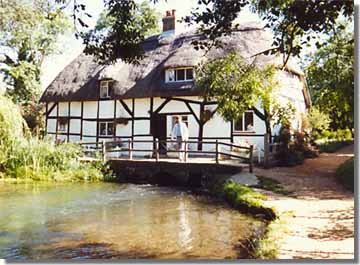
There still stands, on the modest Arle, a mill for the fulling of cloth, the construction (or rebuilding) of whose predecessor is detailed in the 1210/11 Pipe Roll; at the same time we hear that an 'old mill' (probably also for fulling) was moved or dismantled and its site refurbished, by putting down solid new foundations of stone and mortar, as a prelude to erecting the new mill, while a mill-pool was created to channel water to power the mill. Access to clean, fast-running water was a requirement of this element of the cloth-finishing industry and much of the present mill is built directly above the river. The great pond created by the bishop's weir supplied a source of fast-running water for the operation of mills. As the builder of the mill, the bishop couild charge the fuller a much higher rent (perhaps commensurate with the structure's revenue-generating potential) than was demanded for a normal burgage tenement.
England's wool was known throughout medieval Europe for its quality (although that of southern England was not the finest produced in the country), and the wool and cloth trades were a major element in the English economy from the twelfth to the fifteenth century. At first it was the export of raw wool to cloth-producing centres of Flanders and Italy that was important, particularly in the earlier period, as a growing population across Europe produced greater demand for clothing.
English merchants and entrepreneurs came to realize the sense in using the wool to produce cloth domestically (rather than buy it back from Europe). They invested in the development of an existing, modest, rural cloth-producing industry (with a corresponding adverse effect on the elements of that industry already established in the larger towns); many fulling mills were built in the thirteenth century. Cloth manufacture employed a large number of townsmen in its various stages (e.g. shearing, carding, combing, spinning, weaving, fulling, felting, dyeing, cutting). Fulling was a two-part process:
- newly-woven cloth was cleaned by soaking it in clean water and then beating it, usually with water-driven mechanical paddles;
- the cloth was thickened by scrubbing it with "fuller's earth" (aluminium oxide) which provided a good texture and initiated bleaching, a process later completed by the cloth-owners who stretched the cloth out to dry over a wooden frame called a "tenter".
In the fourteenth century, wool exports were declining and those of cloth increasing. The Merchant Staplers increasingly dominated the wool trade during that century. At the end of the century and into the fifteenth (although it is difficult and dangerous to generalize for all areas of the country) there was a downturn in commerce, greater competition in the cloth trade from foreign merchants – notably those of the Hanseatic League – who acquired advantageous privileges from the king, and later a decline in foreign demand for English cloth (in part due to international political troubles) which was offset a little by growing domestic demand. The economies of many of the larger towns were adversely affected, while some smaller centres went into decay as the larger towns tried to dominate what commerce remained. Most large towns were sufficiently diversified in their economies to weather the storm.
For a plan showing the location of the fulling mill, see the Alresford Web site .