| Created: March 7, 1999. Last update: November 29, 2010 | © Stephen Alsford, 1999-2010 |
As the second city of the kingdom – in effect the northern capital – and with the archbishop of York the second most important churchman in England, York not surprisingly is home to what is the largest cathedral in England and one of its most important surviving medieval buildings.
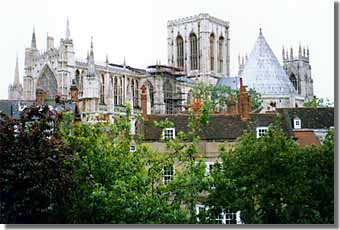
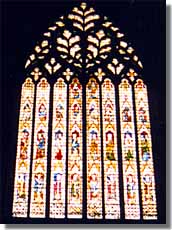
The cathedral that dominates York's skyline almost as much today as it must have done during the Middle Ages was constructed between 1220 and 1472. It is distinguished not only by the predominantly Gothic architecture, but also by decoration such as stained-glass windows and numerous elaborately carved roof bosses – some of these the original medieval pieces, others copies made after the several fires which have ravaged the cathedral over the last two centuries.
The cathedral was built on the site once occupied by the fort of the Roman legion based at York. The city had a bishop at the close of the period of Roman occupation, and what is considered the first episcopal church was built by the newly-Christianized Edgar, king of Northumbria, in the 620s. Even under the rule of the Vikings, a line of archbishops managed to survive, with a few interruptions. Destruction during attacks on the city by the Normans in 1069 and the Danes in 1075, and a fire in 1137 provided only setbacks to rebuilding initiatives. In the early thirteenth century Archbishop Walter de Gray undertook not only to reform the monastic chapter, but also to rebuild the Minster on a scale rivalling Canterbury. The outcome was, eventually, the present building.
For further information about the cathedral, see Wikipedia and the York Minster Virtual Tour.