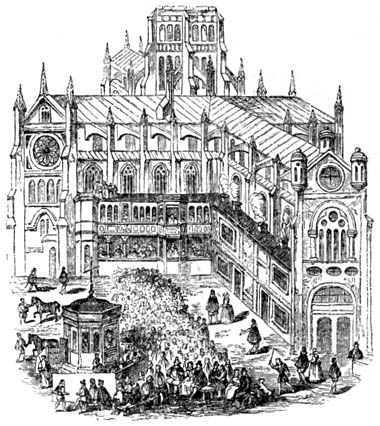
From H.A. Harben, A Dictionary of London,
1918, p.463.
The folkmoot, or "meeting of the people", was an ancient institution having judicial and legislative functions; outlawries were promulgated there. As a general assembly of the community it was a source of authority for local government, and an outlet for the voice of the community or of individual members of that community. But as the meeting-place of a potentially unruly crowd, with little scope for democratic discussion – decisions likely being reached on a "loudest shout" principle – it was also susceptible to manipulation. Practical government came increasingly to focus on the husting, the prime venue for legal disputes of a private nature; the husting could meet more frequently (weekly), under a roof and within walls that could not accommodate much of a crowd.
The site of the London folkmoot lay in what would later be the northeast corner of St. Paul's churchyard (more extensive than it is now), close to the food markets of Cornmarket and Cheapside, which was then the effective nucleus of the city, and perhaps to a royal palace. It is not known if this location was chosen for proximity to the church, a reminder of the need to act honestly before God, or whether the cathedral was built nearby because it was a spacious open area, such as an assembly of many hundreds of people would require. The earliest version of the cathedral dates back to the early seventh century, but the moot could have been at least as old. As part of their claims of the ancient origins of London, associated with legendary figures, the citizens attributed the folkmoot to Arthur.
The building shown in the illustration above was that constructed during the two centuries following the Conquest, and was destroyed in the Great Fire of London. The ringing of the bells of St. Paul's served to summon Londoners to folkmoots three times a year; in pre-Conquest times it may have met more frequently, at need. A High Cross was erected in the churchyard near the folkmoot site and became a platform for preachers to the citizenry, then and later – as the Tudor event depicted above shows. The stone cross shown in the illustration was a replacement put up in 1449, but the elaborate building surrounding it was post-medieval.
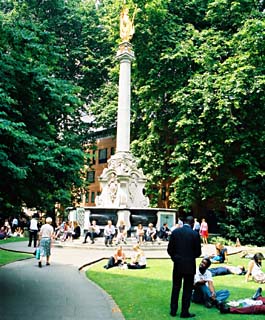
The site of the London folkmoot in St. Paul's
churchyard remains a popular gathering place.
Photo © S. Alsford
In the context of the baronial opposition to King John that led to Magna Carta, the city (supporting the barons) drew up an outline of its own demands, apparently intending to seek a royal charter granting more detailed clauses. Some of London's demands involved it flexing its muscle, such as by insisting the king not impose any tallage without agreement of both kingdom and city; others may have been intended to revoke restrictions of liberties the city had held in the past. Also on the list was the requirement that the mayor be elected annually in the folkmoot; this may reflect political differences, even a power struggle, internal to the London community. The office of mayor appeared about the time that London had obtained from Prince John, in return for its support, the grant of a commune (a status implying increased power and independence). King John's charter of May 1215 now gave clear official recognition to the city's right to elect a mayor each year.
As time went on, the aldermen came to monopolize the election of the mayor and, in 1258, the king – as part of an ongoing campaign aimed at reasserting royal authority over London – harnessed growing popular resentment at the conservative turn the commune had taken. He instituted an enquiry into the patriciate's government, and his representative summoned successive folkmoots to obtain community approval for prosecution of the aldermen, succeeding in breaking the faction resisting the king. Just a few years later this reawakening of the folkmoot, as a vehicle for expression of community will, worked against the king, when it was used by the Montfortian party to arouse support for their demands for reform of royal government. The husting and aldermannic government were set aside and the populace, led by a revolutionary mayor, governed through the folkmoot and reasserted control of the mayoral election. This situation did not outlive the aftermath of Evesham.
During the middle decades of the thirteenth century, up to 1272, the folkmoot continued to have some claim, in the context of political factionalism within the city, as the venue for mayoral elections, sometimes when politicians sought to harness people power to obtain or maintain power, or sometimes when the king wanted to win support against the city rulers. Apart from its brief periods of glory in the context of revolution, however, the folkmoot's thrice-yearly formal meetings – compulsory for those who were within the sound of the summoning bell of St. Pauls, unless they were prepared to pay a hefty fine – had been reduced to essentally routine functions: public acknowledgement of new sheriffs elected in September; provision (in December) for the ward-based policing of the city; and, when the hot days of summer rolled around, public declaration of regulations regarding fire prevention.
Most public business had been transferred to the husting court. It was already in the process of being transferred again, to the newer institutions of the courts of mayor and sheriffs. Thirteen years after the folkmoot had been put to the king's use in 1272, Edward I condemned the area around St. Paul's – including the folkmoot site – as a haunt of ne'er-do-wells. He turned it over to St. Paul's to enclose as part of the churchyard; some of the folkmoot site was subsequently built over.