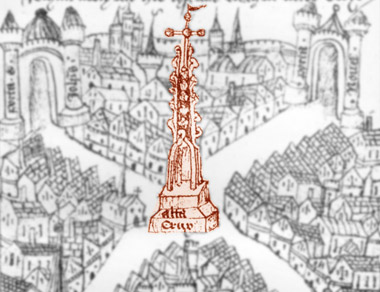
The High Cross at Bristol
from Robert Ricart, The Mayor of Bristowe Is
Kalendar
Bristol's High Cross stood at the crossroads of the four major streets leading into the city: the High Street, Broad Street, Corn Street and Wine Street. The stylized drawing of the city in Ricart's Kalendar serves to emphasize the symbolic location of the cross.
The chief purpose of the cross, however, was to mark the location of a marketplace. In 1403/04 it was ordered that smiths living in the town not sell ironware anywhere except from their shops or beside the High Cross. Likewise, any outsiders were only to sell ironware beside the cross, since this public location would enable supervision of the quality of goods sold. The cross also (at least later in that century) played a part in the ceremonies for the handover of the reins of government from one mayor to the next: it served as the assembly point for town councillors, prior to a procession through the town, accompanying outgoing and incoming mayors to a service at St. Michael's church.
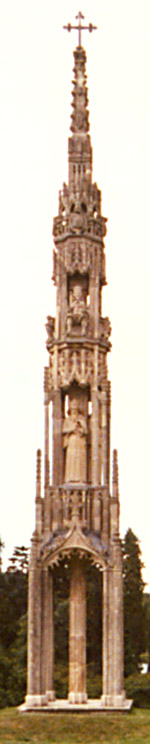
The cross was erected in 1373, the year when Bristol acquired county status, although this does not preclude there having been one earlier. Standing some thirty-nine feet high, it held niches in which were eventually installed statues of kings John, Henry III, Edward III and Edward IV; the first three were probably chosen as the source of important charters of liberties, and the fourth may point to the reign in which the statues were added. The significance of the cross to at least the ruling class of Bristol is indicated in the preparedness to spend £20 in 1491 to paint and gild the embellishments on the monument.
In 1633 alterations were made and other royal figures added: Henry VI (political correctness), Elizabeth I, James I and Charles I, perhaps replacing statues of saints or other religious figures; the cross was later repainted. The obstacle that the monument created at the crossroads, combined with some fear of it collapsing, resulted in 1733 in it being dismantled and put in storage. After public protest, it was re-erected on College Green, owned by the cathedral, but again proved a nuisance to those using the Green. In 1765 the Dean gave it to Henry Hoare (grandson of a London mayor) to ornament the famous landscaped garden at Stourhead.
Minus plinth, the Bristol cross may be viewed today on the Stourhead estate. Photo © S. Alsford
|
|
The High Cross was not the only cross erected at Bristol. Bewell's Cross stood in the Gallows Field at the top of St. Michael's Hill; part of its function was to mark the boundary of the county of Bristol. Also heard of are St. Peter's Cross, near the church of the same dedication, Don John's Cross, and the Stallage Cross in Temple Street.